58k+ listingsShips to NLResponse within one hour+31 73 711 4717info@questpair.com

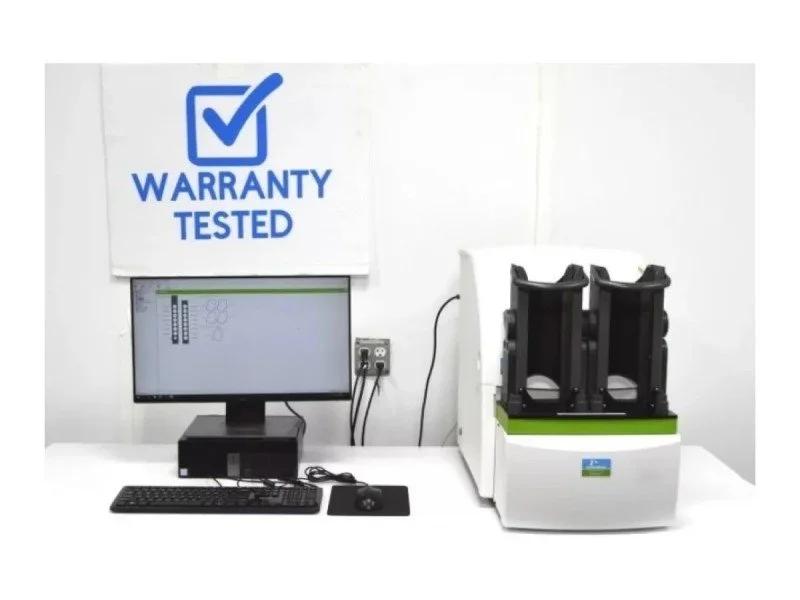
Revvity Perkin Elmer EnVision 2105 Dual Detector Multimode Microplate Reader with Stacker

Price on request

In stock

Can't find what you're looking for?

Stock
In Stock
Product Code
SM100233-ST
All 4 specifications
  • Ships to NL
  • Response within 1 hour
  • Warranty available. Buy without worry
  • Support from a scientist

Specifications 4

Brands
BioLegend
New/Used
Used
Stock
In Stock
Product Code
SM100233-ST

Pre-Owned

Product description

Multimode microplate reader with dual detectors, stacked plate handling, fluorescence, luminescence, absorbance detection.

The Revvity Perkin Elmer EnVision 2105 is a high-throughput dual detector multimode microplate reader designed for versatile biochemical and cellular assay detection, essential in biotechnology and molecular diagnostics workflows including kinase assays, reporter gene assays, and enzyme quantification.

  • Detection modes: Absorbance (ABS), Fluorescence intensity (FL), Fluorescence polarization (FP), Luminescence (LUM), and Time-resolved fluorescence (TRF).
  • Optics & Light source: Xenon flash lamp excitation, photodiode for absorbance, photomultiplier tube (PMT) for fluorescence and luminescence signals with filter-based wavelength selection (230–1000 nm range).
  • Plate formats supported: Compatible with microplates up to 1536 wells, including standard 96- and 384-well formats, enabling high-density screening and multiplex detection.
  • Analysis modes: Supports kinetic, endpoint, and well-area scanning assays suitable for diverse quantitative and qualitative molecular biology and bioprocessing applications.
  • Read times: Rapid scanning with typical read times of 22 s (96-well), 27 s (384-well), and 36 s (1536-well), enhancing throughput in drug discovery and synthetic biology research.
  • Stacker integration: Automated microplate handling with stacker accommodating two stacks (20 or 50 plates) for walk-away operation, crucial for biomanufacturing and cell imaging workflows.
  • Shaking options: Linear, orbital, and dual orbital shaking enhance assay reproducibility for live-cell and enzyme kinetics studies.
  • Sensitivity: High sensitivity with absorbance accuracy <2% at 2 OD, fluorescence intensity detection limit <4 pM fluorescein, fluorescence polarization precision <3 mP, and luminescence sensitivity <75 pM ATP, critical for molecular diagnostics and gene editing assays.
  • Software: Controlled via EnVision software (version 1.14) supporting comprehensive data analysis and assay management.
  • Physical and electrical specs: Weighs 50 kg (110.2 lbs) with dimensions 42 x 55 x 58 cm; powered by 100–240 VAC, 50/60 Hz.
  • Applications: Widely adopted in biotechnology fields for cellular assays, GPCR signaling evaluation, enzyme kinetics, and luminescence quantification in molecular cloning and biopharmaceutical production pipelines.

The EnVision 2105’s integrated multimode detection and automated plate handling make it indispensable for high-throughput screening (HTS), fluorescence-based assays, and luminescence analysis in clinical diagnostics and synthetic biology research. The instrument undergoes rigorous factory service including optical and mechanical system calibration, ensuring precise excitation-to-detection signal integrity without spectral bleed-through or electronic noise interference. Warranty, training, and remote setup support provide turnkey solutions for biotechnology labs seeking reliable operation.

This reader’s flexibility for assay customization, including filter and mirror module options, supports evolving bioprocessing and live-cell imaging demands, making it a critical platform for advanced molecular biology and gene editing experimentation.

Why Questpair exists

Lab equipment markets are fragmented. Buyers spend weeks calling distributors, comparing quotes, and verifying supplier reliability. Sellers struggle to reach global research labs.

We built Questpair to fix this. Every supplier on the platform is verified before listing. Every quote you receive comes from a real, vetted seller. AI prepares your case in minutes, then a real specialist takes over.

We're an independent team based in The Netherlands, working with research labs and procurement teams across Europe and worldwide.

Frequently asked questions

How long does laboratory equipment typically last?

With a service contract, ten to fifteen years is normal for most benchtop instruments. Detectors and pumps are the parts that wear first.

Can I get service for older equipment?

Yes. Every verified supplier states which service partners cover the instrument, and we list that alongside the offer.

Where can I buy parts?

Ask a scientist through the request button. Parts are often available even when the instrument itself is discontinued.

What is the typical lead time for refurbished equipment?

Two to six weeks, depending on refurbishment scope and whether calibration is included.

Does laboratory equipment ship internationally?

We ship to 38 countries. Crating and customs handling are quoted with the instrument.

Reply in one hour

Can't find the exact configuration?

Tell us what you need and a scientist finds it for you, usually within the hour.

Last updated 19 October 2026