53k+ listingsShips to NLResponse within one hour+31 73 711 4717info@questpair.com

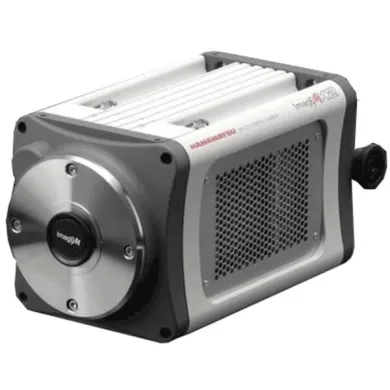
Hamamatsu ImagEM X2-1K Electron Multiplying Back-Thinned EM CCD Camera C9100-24B

Price on request

In stock

Can't find what you're looking for?

Type number
C9100-24B
Camera head type
Hermetic vacuum-sealed air/water-cooled head*1
Window
Anti-reflection (AR) coatings on both sides, single window
AR mask
No
Imaging device
Electron Multiplying Back-Thinned Frame Transfer CCD
All 44 specifications
  • Ships to NL
  • Response within 1 hour
  • Warranty available. Buy without worry
  • Support from a scientist

Specifications 44

Brands
Hamamatsu
New/Used
Used
Type number
C9100-24B
Camera head type
Hermetic vacuum-sealed air/water-cooled head*1
Window
Anti-reflection (AR) coatings on both sides, single window
AR mask
No
Imaging device
Electron Multiplying Back-Thinned Frame Transfer CCD
Effective number of pixels
1024 (H)×1024 (V)
Cell size
13 μm (H)×13 μm (V)
Effective area
13.3 mm (H) × 13.3 mm (V)
Pixel clock rate (EM-CCD readout)
22 MHz, 11 MHz, 0.6875 MHz
Pixel clock rate (NORMAL CCD readout)
0.6875 MHz
EM (electron multiplying) gain
1×, 10× to 1200× (typ.)*2
Ultra low light detection
Photon Imaging mode (1, 2, 3)
Fastest readout speed
18.5 frames/s to 314 frames/s*3
Readout noise (EM-CCD readout)
15 electrons (EM gain 4×, at 22 MHz) (rms) (typ.)10 electrons (EM gain 4×, at 11 MHz) (rms) (typ.)3 electrons (EM gain 4×, at 0.6875 MHz) (rms) (typ.)1 electron max. (EM gain 1200×) (rms) (typ.)
Readout noise (NORMAL CCD readout)
10 electrons (at 0.6875 MHz) (rms) (typ.)
Full well capacity
EM-CCD readout: 400 000 electrons (Max. 800 000 electrons) (typ.)*4NORMAL CCD readout: 50 000 electrons (typ.)
Analog gain
EM-CCD readout (22 MHz): 1×EM-CCD readout (11 MHz/0.6875 MHz): 0.5×, 1×Normal CCD readout: 1×, 2×, 3×, 4×, 5×
Cooling temperature (Forced-air cooled)
At temperature control: -50 ℃ (Room temperature 0 ℃ to +30 ℃, at 22 MHz)At temperature control: -55 ℃ ((Room temperature 0 ℃ to +30 ℃, 11 MHZ, 0.6875 MHz. Normal CCD readout)At maximum cooling (typ.): -65 ℃ (Room temperature: stable at +20 ℃)
Cooling temperature (Water cooled)
At temperature control: -65 ℃ (Water temperature: +20 ℃, at 22 MHz)At temperature control: -70 ℃ (Water temperature: +20 ℃, 11 MHZ, 0.6875 MHz. Normal CCD readout)At maximum cooling (typ.): -80 ℃ (Water temperature: lower than +10 ℃)
Temperature stability (Forced-air cooled)
±0.01 ℃ (typ.)
Temperature stability (Water cooled)
±0.01 ℃ (typ.)
Dark current (Forced-air cooled)
0.01 electron/pixel/s (-65 ℃) (typ.)
Dark current (Water cooled)
0.001 electron/pixel/s (-80 ℃) (typ.)
Clock induced charge
0.01 events/pixel/frame (typ.)
Exposure time (Internal sync mode)
52.7 ms to 1 s (22 MHz)103.2 ms to 2 h (11 MHz)1616.9 ms to 2 h (0.6875 MHz)
Exposure time (External trigger mode)
10 μs to 1 s (22 MHz)10 μs to 2 h (11 MHz, 0.6875 MHz)
A/D converter
16 bit
Output signal/External control
IEEE1394b
Sub-array
Every 16 lines (horizontal, vertical) size, position can be set
Binning
2×2, 4×4
External trigger mode
Edge trigger, Level trigger, Start trigger, Synchronous readout trigger
Trigger output
Exposure timing output, Programmable timing output (Delay and pulse length are variable.), Trigger ready output
Image processing features (real-time)
Background subtraction, Shading correction, Recursive filter, Frame averaging, Spot noise reducer*5
EM gain protection
EM warning mode, EM protection mode
EM gain readjustment
Available
Lens mount
C-mount
Power supply
AC 100 V to 240 V, 50 Hz / 60 Hz
Power consumption
Approx. 140 VA
Ambient storage temperature
-10 °C to + 50 °C
Ambient operating temperature
0 °C to + 40 °C
Performance guaranteed temperature
0 °C to + 30 °C
Ambient operating/storage humidity
70 % max. (with no condensation)

Product description

High-speed 1024×1024 EM CCD camera with ultra-low noise and deep cooling for quantitative ultra-low light imaging.

The Hamamatsu ImagEM X2-1K (model C9100-24B) is a high-sensitivity back-thinned electron multiplying CCD camera designed for quantitative ultra-low light imaging. It features:

  • Imaging device: Electron Multiplying Back-Thinned Frame Transfer CCD
  • Effective pixels: 1024 × 1024, pixel size 13 μm × 13 μm
  • Full well capacity: Up to 400,000 electrons (EM-CCD readout), max 800,000 electrons (not linear above 400,000)
  • EM gain range: 1×, 10× to 1200× typical
  • Frame rates: 18.5 fps (full frame) up to 314 fps (binned/sub-array)
  • Readout noise: As low as 1 electron rms (EM gain 1200×), varies with pixel clock rates
  • Cooling: Hermetic vacuum-sealed head with forced-air or water cooling achieving temperatures down to -80 °C
  • Dark current: Extremely low, 0.01 electron/pixel/s at -65 °C (air cooled), 0.001 electron/pixel/s at -80 °C (water cooled)
  • Exposure time range: Internal sync 52.7 ms to 2 h, external trigger 10 μs to 2 h
  • Connectivity: IEEE1394b interface for data and control
  • Special features: On-board EM gain protection, multiple external trigger modes, lens mount C-mount, multiple real-time image processing options (background subtraction, shading correction, recursive filtering, frame averaging, spot noise reduction)
  • Physical: Hermetic vacuum-tight camera head maintains 10^-8 Torr without re-evacuation
  • Power: AC 100–240 V, 50/60 Hz, ~140 VA consumption
  • Operating environment: 0 °C to 40 °C, 70% max humidity, no condensation

The camera delivers maximum speed and precision for advanced scientific imaging in near-dark conditions, long integration, or high-speed acquisition scenarios.

Why Questpair exists

Lab equipment markets are fragmented. Buyers spend weeks calling distributors, comparing quotes, and verifying supplier reliability. Sellers struggle to reach global research labs.

We built Questpair to fix this. Every supplier on the platform is verified before listing. Every quote you receive comes from a real, vetted seller. AI prepares your case in minutes, then a real specialist takes over.

We're an independent team based in The Netherlands, working with research labs and procurement teams across Europe and worldwide.

Frequently asked questions

How long does laboratory equipment typically last?

With a service contract, ten to fifteen years is normal for most benchtop instruments. Detectors and pumps are the parts that wear first.

Can I get service for older equipment?

Often, yes. Verified suppliers frequently work with service partners converting the instrument. If applicable, we can list servicing options alongside the offer.

Where can I buy parts?

Ask a scientist through the request button. Parts are often available even when the instrument itself is discontinued.

What is the typical lead time for refurbished equipment?

Two to six weeks, depending on refurbishment scope and whether calibration is included.

Does laboratory equipment ship internationally?

We ship to 38 countries. Crating and customs handling are quoted with the instrument.

Reply in one hour

Can't find the exact configuration?

Tell us what you need and a scientist finds it for you, usually within the hour.

Last updated 2 November 2026