53k+ listingsShips to NLResponse within one hour+31 73 711 4717info@questpair.com

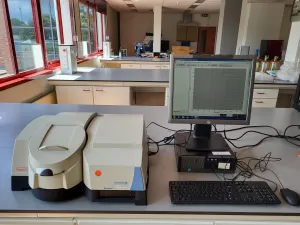
Thermo Scientific Evolution 300 BB UV-Vis Spectrophotometer with VISIONsecurity Software and PC

From€5,000excl. VAT

In stock

Can't find what you're looking for?

Brands
Thermo Fisher Scientific
New/Used
Used
  • Ships to NL
  • Response within 1 hour
  • Warranty available. Buy without worry
  • Support from a scientist

Product description

Thermo Scientific Evolution 300 BB UV-Vis Spectrophotometer with double-beam optics, 190 to 1100 nm range, VISIONsecurity and PC.

The Thermo Scientific Evolution 300 BB UV-Vis spectrophotometer is a double-beam instrument for absorbance, transmittance, reflectance and concentration measurements. UV-Vis spectrophotometry supports biochemical analysis, life science research, pharmaceutical laboratory work and quality control.

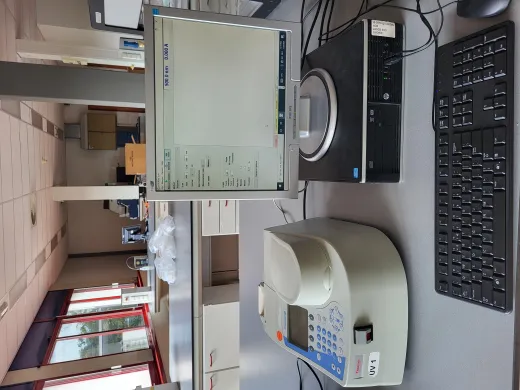
The unit includes VISIONsecurity and Visionlife software, a PC, monitor, keyboard, mouse and a rotary multi-position sample accessory. The accessory provides multiple sample positions. A Peltier connection is present on the rear panel. The system has sample and reference cuvette or accessory positions.

The used instrument has been tested with an external Thermo Scientific UV Validator kit. A holmium scan from that test is shown in the supplied photos. The UV Validator kit is not included. The unit is in good condition.

Optical system

  • Modified Ebert double-beam optical design
  • Wavelength range: 190 to 1100 nm
  • Holographic grating with 1200 lines/mm, blazed at 240 nm
  • Beam separation: 210 mm
  • Xenon flash lamp
  • Dual matched silicon photodiodes
  • Variable spectral bandwidths: 0.5, 1.0, 1.5, 2.0 and 4.0 nm
  • Sample and reference cuvette or accessory positions
  • Smart accessory support
  • Peltier connection on the rear panel

Measurement and scanning

  • Readout modes: absorbance, percentage transmittance, percentage reflectance and concentration
  • Additional scan ordinate modes: absorbance, percentage transmittance, percentage reflectance, concentration and first to fourth derivative
  • Photometric range: greater than 4 A
  • Display range: plus or minus 6 A
  • Scanning speeds: 3800, 2400, 1200, 600, 240, 120, 60, 30, 10, 5 and 1 nm/min
  • Data intervals: 10, 5, 2, 1, 0.5, 0.2, 0.1 and 0.05 nm

Performance specifications

  • Wavelength accuracy: plus or minus 0.20 nm at the 546.11 nm mercury emission line
  • Wavelength accuracy: plus or minus 0.30 nm from 190 to 900 nm
  • Wavelength repeatability: standard deviation of 10 measurements less than 0.05 nm
  • Photometric accuracy: 1 A plus or minus 0.004 A, 2 A plus or minus 0.004 A, and 3 A plus or minus 0.006 A
  • Photometric noise at 500 nm and 2.0 nm spectral bandwidth: 0 A less than 0.00018 A, 1 A less than 0.00022 A, and 2 A less than 0.00050 A
  • Drift: less than 0.0005 absorbance per hour at 500 nm and 2.0 nm spectral bandwidth after a 2 hour warm-up
  • Stray light: 198 nm, 2.9 A KCl; 220 nm, 4.2 A NaI; 340 nm, 4.3 A NaNO2
  • Baseline flatness: plus or minus 0.0015 A from 200 to 800 nm at 2.0 nm spectral bandwidth, smoothed

Included configuration

  • Part number: 10300101
  • VISIONsecurity software
  • Visionlife software
  • PC, monitor, keyboard and mouse
  • Rotary multi-position accessory or carousel
  • Beam height marking on the installed accessory: 8.5 mm
  • UV Validator kit used for testing is not included

Electrical and physical specifications

  • Electrical supply: 100 to 240 V, 50/60 Hz
  • Power consumption: 150 VA according to the type plate
  • Dimensions, W x D x H: approximately 61 x 53 x 38 cm
  • Weight: approximately 22 kg
  • Condition: used and in good condition
  • Testing: tested with a Thermo Scientific UV Validator kit, with a holmium scan shown in the supplied photos

What these specifications mean

The 190 to 1100 nm wavelength range covers ultraviolet and visible spectrophotometry within one instrument. Variable spectral bandwidths from 0.5 to 4.0 nm allow the selected measurement resolution to be matched to the method.

VISIONsecurity provides controlled access, audit trails and electronic record functions for regulated laboratory environments. The available readout modes cover absorbance, transmittance, reflectance and concentration, with first to fourth derivative scan ordinate modes for spectral analysis.

Why Questpair exists

Lab equipment markets are fragmented. Buyers spend weeks calling distributors, comparing quotes, and verifying supplier reliability. Sellers struggle to reach global research labs.

We built Questpair to fix this. Every supplier on the platform is verified before listing. Every quote you receive comes from a real, vetted seller. AI prepares your case in minutes, then a real specialist takes over.

We're an independent team based in The Netherlands, working with research labs and procurement teams across Europe and worldwide.

Frequently asked questions

How long does laboratory equipment typically last?

With a service contract, ten to fifteen years is normal for most benchtop instruments. Detectors and pumps are the parts that wear first.

Can I get service for older equipment?

Often, yes. Verified suppliers frequently work with service partners converting the instrument. If applicable, we can list servicing options alongside the offer.

Where can I buy parts?

Ask a scientist through the request button. Parts are often available even when the instrument itself is discontinued.

What is the typical lead time for refurbished equipment?

Two to six weeks, depending on refurbishment scope and whether calibration is included.

Does laboratory equipment ship internationally?

We ship to 38 countries. Crating and customs handling are quoted with the instrument.

Reply in one hour

Can't find the exact configuration?

Tell us what you need and a scientist finds it for you, usually within the hour.

Last updated 5 November 2026