Price on request
In stock
Can't find what you're looking for?
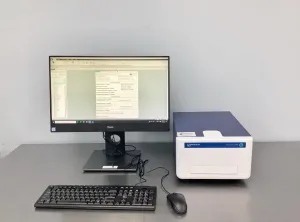
UV-Vis microplate reader with 190-1000 nm range, monochromator optics, cuvette option, and precise temperature control.
The Molecular Devices SpectraMax ABS Plus Microplate Reader offers precise absorbance measurements spanning a broad UV-visible wavelength range from 190 nm to 1000 nm, making it ideal for biotechnology, molecular diagnostics, and bioprocessing workflows. Utilizing a monochromator with 1.0 nm tunable increments and a 2 nm bandwidth, the reader supports high spectral resolution and wavelength accuracy of less than ±1.0 nm. It delivers minimal stray light (≤0.05% at 230 nm), ensuring reliable and reproducible data essential in synthetic biology and molecular cloning applications.
This model uniquely supports multiple plate formats including 96- and 384-well microplates as well as a cuvette option exclusive to the ABS Plus, providing versatility for diverse assay requirements in cell imaging and fluorescence analysis laboratories. The patented multi-channel optical system measures sample depth directly on the plate and normalizes readings to a standard 1 cm cuvette pathlength, facilitating faster workflows by eliminating the need for precise pipetting volumes. This feature also enables rapid validation of multi-channel dispensers and pipettes, critical in biomanufacturing quality control.
Key operational features include user-programmable Automix for temperature and mixing uniformity with ±0.75°C stability at 37°C, important for kinetic assays and live-cell studies. The instrument integrates seamlessly with automated platforms such as the Molecular Devices StakMax plate stacker and other robotic systems, supporting high-throughput screening in clinical diagnostics and biotechnology research.
Performance specifications underscore fast kinetic read times—9 seconds for 96-well and 29 seconds for 384-well plates—powered by a robust 5W Xenon flash lamp rated for up to 1 billion flashes. The unit employs sensitive silicon photodiode detectors with top-down illumination and linear plate shaking to enhance assay consistency.
Compact and robust, the reader measures 8 x 12 x 16.3 inches, weighs 30 lbs, and operates on universal power supply (100-240V, 50/60 Hz, 3A), suitable for a range of laboratory environments specializing in molecular biology, bioprocessing, and biomedical engineering.
This SpectraMax ABS Plus microplate reader is a precision instrument widely used in molecular diagnostics and synthetic biology research, essential for absorbance-based assays requiring high sensitivity and throughput in biotech and clinical settings.
Lab equipment markets are fragmented. Buyers spend weeks calling distributors, comparing quotes, and verifying supplier reliability. Sellers struggle to reach global research labs.
We built Questpair to fix this. Every supplier on the platform is verified before listing. Every quote you receive comes from a real, vetted seller. AI prepares your case in minutes, then a real specialist takes over.
We're an independent team based in The Netherlands, working with research labs and procurement teams across Europe and worldwide.
With a service contract, ten to fifteen years is normal for most benchtop instruments. Detectors and pumps are the parts that wear first.
Yes. Every verified supplier states which service partners cover the instrument, and we list that alongside the offer.
Ask a scientist through the request button. Parts are often available even when the instrument itself is discontinued.
Two to six weeks, depending on refurbishment scope and whether calibration is included.
We ship to 38 countries. Crating and customs handling are quoted with the instrument.
Tell us what you need and a scientist finds it for you, usually within the hour.
Last updated 19 October 2026
The middle half of the 147 with a price runs from €178 to €8,624.