53k+ listingsShips to NLResponse within one hour+31 73 711 4717info@questpair.com

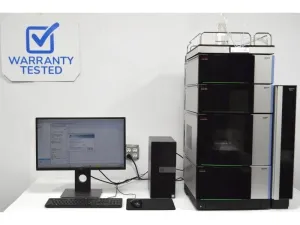
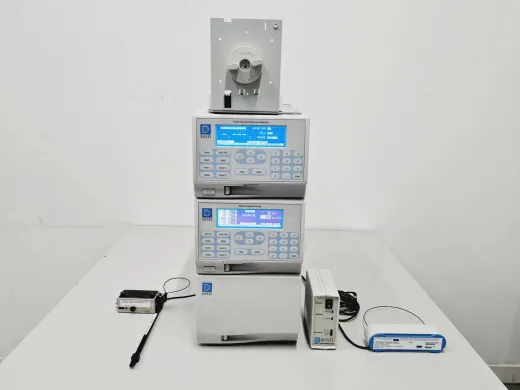
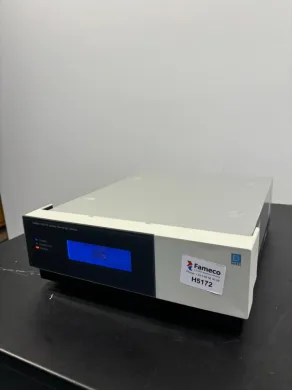
Thermo Scientific Vanquish Flex Quaternary UHPLC System with Variable Wavelength and Fluorescence Detectors

Price on request

In stock

Can't find what you're looking for?

Stock
In Stock
Product Code
68742
Detector Type
UV/Vis (Variable), Fluorescence
System Type
UHPLC (Quaternary)
Max Pressure
1030 bar
All 10 specifications
  • Ships to NL
  • Response within 1 hour
  • Warranty available. Buy without worry
  • Support from a scientist

Specifications 10

Brands
Thermo Fisher Scientific
New/Used
Used
Stock
In Stock
Product Code
68742
Detector Type
UV/Vis (Variable), Fluorescence
System Type
UHPLC (Quaternary)
Max Pressure
1030 bar
Wavelength Range
190 to 900 nm
Detectors
UV/Vis, Fluorescence
Detail
Flow Cell Included

Pre-Owned

Product description

Quaternary UHPLC system with VWD, fluorescence detection, autosampler, column compartment, and Chromeleon software.

The Thermo Scientific Vanquish Flex Quaternary UHPLC System is a modular high-performance liquid chromatography platform configured with a quaternary pump, split-loop autosampler, thermostatted column compartment, variable wavelength UV/Vis detector, fluorescence detector, and Chromeleon software v.7.3.1. It is suitable for pharmaceutical analysis, bioanalytical quantification, impurity profiling, stability testing, biomarker analysis, and complex separation workflows in biotechnology and molecular diagnostics.

Included Configuration

  • Vanquish Quaternary Pump F, p/n VF-P20-A
  • Serial dual-piston operating principle
  • Flow range: 0.001–8 mL/min, in 1 uL/min increments
  • Pressure range: 2–103 MPa; above 5 mL/min, pressure range decreases to 80 MPa
  • Four solvent lines with low-pressure gradient proportioning
  • Static mixer volume: 350 uL
  • Dwell volume: 679 uL
  • Built-in four-channel solvent degassing
  • Flow accuracy: ±0.1%
  • Flow precision: <0.05% RSD or <0.01 min SD, whichever is greater
  • Pulsation: typically <1.0% or <0.2 MPa, whichever is greater
  • Proportioning accuracy: ±0.5% of full-scale
  • Proportioning precision: <0.15% SD
  • Fully automated compressibility compensation independent of mobile-phase composition
  • Vanquish Split Sampler FT, p/n VF-A10-A
  • Split-loop injection with 1 injection unit
  • Pressure range: 2–103 MPa
  • Injection volume range: 0.01–100 uL, with 0.01 uL minimum step
  • Injection volume accuracy: typically ±0.5% for 10 uL water
  • Injection volume precision: <0.25% area RSD for 1 uL caffeine in water; typically <0.5% area RSD for 0.5 uL
  • Injection cycle time: down to 8 s, depending on separation conditions
  • Minimum sample required: 2 uL at 1 uL injection volume
  • UV carryover: <0.002% with caffeine; typically <0.0004%
  • External needle wash with one solvent per injection unit, dip rinse, and continuous rinse
  • Sample compartment temperature range: 4–40 °C
  • Sample temperature accuracy: −2 °C/+4 °C
  • Sample temperature stability: ±1 °C
  • Capacity for 4 SBS-format rack or well-plate segments, plus 12 × 22.5 mm outer-diameter vials in the carousel
  • Includes 3 sample racks, each with 54 positions for 12 mm outer-diameter vials up to 1.5 mL
  • Barcode functions include empty-segment detection, rack or well-plate verification, and inventory management
  • Vanquish Column Compartment H, p/n VH-C10-A
  • Still-air and forced-air column chamber
  • Temperature range: 5–120 °C in 0.1 °C increments
  • Temperature stability: ±0.05 K
  • Temperature accuracy: ±0.5 K up to 80 °C
  • Heating performance: <15 min from 20–50 °C at ±1 K; typically 5 min from 25–40 °C
  • Cooling performance: <15 min from 50–20 °C at ±1 K
  • Capacity: 2 column slots

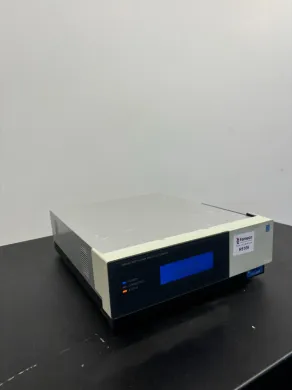
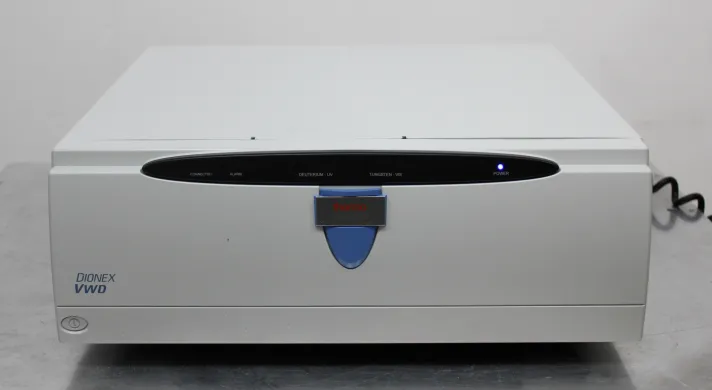
Variable Wavelength UV/Vis Detector

The Vanquish Variable Wavelength Detector F, p/n VF-D40-A, uses a UV/Vis/NIR photometer with a tunable Czerny-Turner monochromator and an internal reference beam.

  • Light sources: deuterium lamp for UV and visible wavelengths; tungsten lamp for visible and near-infrared wavelengths
  • Wavelength range: 190–900 nm
  • Spectral bandwidth: typically 6 nm at 254 nm
  • Wavelength accuracy: ±1 nm
  • Wavelength repeatability: ±0.1 nm
  • Internal wavelength calibration using the zero order of the monochromator spectrum
  • Internal wavelength validation using a holmium-oxide filter
  • Up to 4 signal channels
  • Data collection rate: up to 250 Hz in single-channel mode and up to 5 Hz in multi-channel mode
  • Single-channel noise: <±2.5 uAU at 254 nm
  • Multi-channel noise: <±10 uAU, typically <±7 uAU, at 254 nm and 280 nm
  • Drift: <0.1 mAU/h at 254 nm
  • Linearity: <5% at 2.5 AU, typically <3% at 2.5 AU
  • Includes Standard Bio flow cell, p/n 6077.0200: 11 uL, 10 mm path length, 50 bar

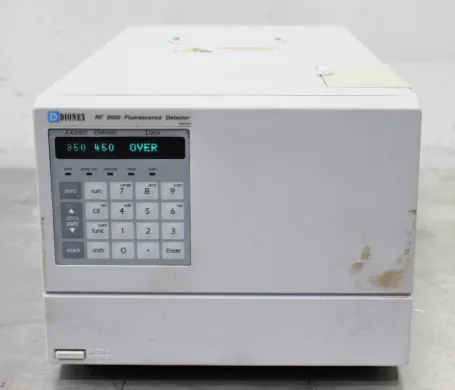
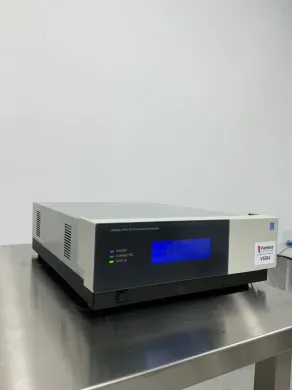
Fluorescence Detector

The Vanquish Fluorescence Detector F, p/n VF-D50-A, provides selective fluorescence analysis using two monochromators with concave holographic gratings and elliptic mirrors.

  • Light source: 15 W xenon flash lamp
  • Photomultipliers: 1
  • Excitation wavelength range: 220–630 nm
  • Emission wavelength range: 220–650 nm
  • Excitation and emission spectral bandwidth: 20 nm
  • Wavelength accuracy: ±2 nm
  • Wavelength repeatability: ±0.2 nm
  • Scan modes: excitation, emission, and synchronous single-spectrum scans
  • Up to 4 channels
  • Data collection rate: up to 200 Hz
  • Wavelength switching time: <250 ms
  • Variable emission filter with 5 positions
  • Includes Standard Bio fused-silica flow cell, p/n 6079.4230: 8 uL, 20 bar (2 MPa)

Applications

This pre-owned Thermo Scientific UHPLC system is configured for:

  • Pharmaceutical assay and impurity profiling
  • Trace detection of fluorescent biomarkers
  • Protein and peptide bioanalysis
  • Stability and degradation studies
  • Multi-component mixture separation and identification
  • Fluorescence analysis in biotechnology and life-science research
  • Quantitative UV/Vis methods for pharmaceutical and molecular biology workflows

The system includes a PC loaded with Chromeleon software v.7.3.1, a solvent rack, intercommunication cables, standard power cords, and the specified detector flow cells and sample racks. The listed instrument was manufactured in 2022–2023 and underwent initialization, self-test, software communication, pump, autosampler, column compartment, detector, leak-sensor, and test-injection checks.

Why Questpair exists

Lab equipment markets are fragmented. Buyers spend weeks calling distributors, comparing quotes, and verifying supplier reliability. Sellers struggle to reach global research labs.

We built Questpair to fix this. Every supplier on the platform is verified before listing. Every quote you receive comes from a real, vetted seller. AI prepares your case in minutes, then a real specialist takes over.

We're an independent team based in The Netherlands, working with research labs and procurement teams across Europe and worldwide.

Frequently asked questions

How long does laboratory equipment typically last?

With a service contract, ten to fifteen years is normal for most benchtop instruments. Detectors and pumps are the parts that wear first.

Can I get service for older equipment?

Often, yes. Verified suppliers frequently work with service partners converting the instrument. If applicable, we can list servicing options alongside the offer.

Where can I buy parts?

Ask a scientist through the request button. Parts are often available even when the instrument itself is discontinued.

What is the typical lead time for refurbished equipment?

Two to six weeks, depending on refurbishment scope and whether calibration is included.

Does laboratory equipment ship internationally?

We ship to 38 countries. Crating and customs handling are quoted with the instrument.

Reply in one hour

Can't find the exact configuration?

Tell us what you need and a scientist finds it for you, usually within the hour.

Last updated 4 November 2026