53k+ listingsShips to NLResponse within one hour+31 73 711 4717info@questpair.com
Procurable · sourced on request

NASA Operational Land Imager (OLI)

UsedNASAImaging systems - otherNetherlands
Procurable

Not in stock, available to order through our sourcing team

Not in stock, but we can get it for you

We source this model through our supplier network. Request a quote and we'll come back within one hour.

  1. Request a quote
  2. We confirm price and lead time
  3. You approve, we ship to you
Spatial Resolution (Panchromatic Band)
15 m
Spatial Resolution (Multispectral Bands)
30 m
Spectral Range
0.43 µm to 2.29 µm
Swath Width
185 km
Radiometric Quantization (Landsat 8)
12-bit
Availability
Procurable
Lead time
Confirmed with your quote
All 20 specifications
  • Ships to NL
  • Response within 1 hour
  • Warranty available. Buy without worry
  • Support from a scientist

Specifications 20

Brands
NASA
New/Used
Used
Spatial Resolution (Panchromatic Band)
15 m
Spatial Resolution (Multispectral Bands)
30 m
Spectral Range
0.43 µm to 2.29 µm
Swath Width
185 km
Radiometric Quantization (Landsat 8)
12-bit
Radiometric Quantization (Landsat 9)
14-bit
Detector Count per Spectral Band
Over 7,000
Design Life
5 years
Power Supply
Provided by Landsat 8 spacecraft
Voltage
Not specified
Current
Not specified
Sample Volume
Not applicable
Compatible Materials
Not applicable
Detection Limits
Not specified
Measurement Range
Not specified
Data Output Format
Not specified
Availability
Procurable
Lead time
Confirmed with your quote

Product description

Multispectral imaging sensor on Landsat 8/9 with 30m resolution, 9 bands, 185 km swath, 12-bit radiometric sensitivity.

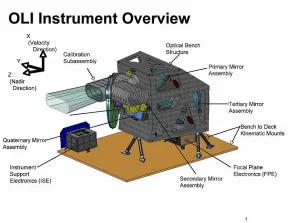
Operational Land Imager (OLI) is a state-of-the-art multispectral imaging sensor aboard NASA's Landsat 8 and Landsat 9 satellites, designed to capture high-resolution images of Earth's land surfaces. This instrument plays a pivotal role in monitoring environmental changes, land use, and natural resources.

Key features include:

  • Spectral Bands: Nine narrow-band channels spanning the visible, near-infrared, and shortwave infrared spectra, plus a panchromatic band.
  • High Resolution: Delivers 30-metre spatial resolution for multispectral bands and 15-metre for the panchromatic band.
  • Wide Swath Coverage: Captures a 185 km swath, enabling comprehensive regional analysis.
  • Enhanced Radiometric Sensitivity: Utilises 12-bit quantisation, providing 4,096 possible values per pixel, allowing detection of subtle differences in surface reflectance.
  • Push-Broom Design: Employs a push-broom scanning technique with over 7,000 detectors per spectral band, enhancing sensitivity and reducing mechanical complexity.

OLI's data is instrumental in various scientific fields:

  • Environmental Monitoring: Assessing deforestation, urban expansion, and habitat loss.
  • Agriculture: Evaluating crop health, soil moisture, and irrigation practices.
  • Geology: Mapping mineral resources and geological formations.
  • Hydrology: Monitoring water bodies, wetlands, and coastal zones.

This instrument is widely utilised by:

  • Research Institutions: Universities and environmental research centres.
  • Government Agencies: Organisations like the US Geological Survey (USGS) and NASA.
  • Non-Governmental Organisations (NGOs): Focused on conservation and land management.

Operational since 2013, OLI continues to provide critical data for global environmental monitoring and resource management.

Why Questpair exists

Lab equipment markets are fragmented. Buyers spend weeks calling distributors, comparing quotes, and verifying supplier reliability. Sellers struggle to reach global research labs.

We built Questpair to fix this. Every supplier on the platform is verified before listing. Every quote you receive comes from a real, vetted seller. AI prepares your case in minutes, then a real specialist takes over.

We're an independent team based in The Netherlands, working with research labs and procurement teams across Europe and worldwide.

Frequently asked questions

How long does laboratory equipment typically last?

With a service contract, ten to fifteen years is normal for most benchtop instruments. Detectors and pumps are the parts that wear first.

Can I get service for older equipment?

Often, yes. Verified suppliers frequently work with service partners converting the instrument. If applicable, we can list servicing options alongside the offer.

Where can I buy parts?

Ask a scientist through the request button. Parts are often available even when the instrument itself is discontinued.

What is the typical lead time for refurbished equipment?

Two to six weeks, depending on refurbishment scope and whether calibration is included.

Does laboratory equipment ship internationally?

We ship to 38 countries. Crating and customs handling are quoted with the instrument.

Reply in one hour

Can't find the exact configuration?

Tell us what you need and a scientist finds it for you, usually within the hour.

Last updated 5 November 2026