58k+ listingsShips to NLResponse within one hour+31 73 711 4717info@questpair.com
Procurable · sourced on request

NASA MODIS

UsedNASAEnvironmental chambersNetherlands
Procurable

Not in stock, available to order through our sourcing team

Not in stock, but we can get it for you

We source this model through our supplier network. Request a quote and we'll come back within one hour.

  1. Request a quote
  2. We confirm price and lead time
  3. You approve, we ship to you
Orbit Altitude
705 km
Orbit Type
Sun-synchronous, near-polar, circular
Design Life
6 years
Scan Rate
20.3 rpm
Swath Dimensions
2330 km (cross track) by 10 km (along track at nadir)
Availability
Procurable
Lead time
Confirmed with your quote
All 23 specifications
  • Ships to NL
  • Response within 1 hour
  • Warranty available. Buy without worry
  • Support from a scientist

Specifications 23

Brands
NASA
New/Used
Used
Orbit Altitude
705 km
Orbit Type
Sun-synchronous, near-polar, circular
Design Life
6 years
Scan Rate
20.3 rpm
Swath Dimensions
2330 km (cross track) by 10 km (along track at nadir)
Spatial Resolution
250 m (bands 1-2), 500 m (bands 3-7), 1000 m (bands 8-36)
Temporal Resolution
1-2 days
Field of View
110 degrees
Geolocation Control
3600 arcsec
Geolocation Knowledge
141 arcsec
Geolocation Stability
28 arcsec/sec
Geolocation Jitter
1031 arcsec/sec (yaw and roll), 47 arcsec/sec (pitch)
Telescope Diameter
17.78 cm
Instrument Dimensions
1000 mm x 1600 mm x 1000 mm
Instrument Weight
228.7 kg
Power Consumption
162.5 W (single orbit average)
Data Rate
10.6 Mbps (peak daytime); 6.1 Mbps (orbital average)
Quantization
12 bits
Spectral Bands
36 bands ranging from 0.4 µm to 14.4 µm
Availability
Procurable
Lead time
Confirmed with your quote

Product description

Satellite sensor with 36 spectral bands (0.4–14.4 µm) providing global Earth data every 1–2 days since 1999.

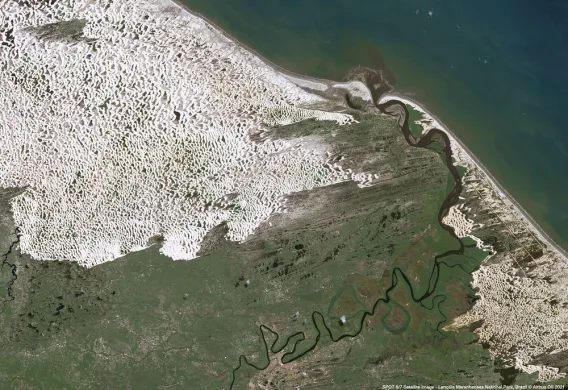
The Moderate Resolution Imaging Spectroradiometer (MODIS) is a satellite-based sensor designed to monitor Earth's surface and atmosphere, providing critical data for environmental and climate research. Launched aboard NASA's Terra satellite in 1999 and the Aqua satellite in 2002, MODIS has been operational for over two decades, delivering comprehensive global coverage every 1 to 2 days.

Key features include:

  • 36 spectral bands spanning wavelengths from 0.4 µm to 14.4 µm, enabling diverse applications from visible to thermal infrared imaging.
  • Multiple spatial resolutions of 250 m, 500 m, and 1 km, facilitating detailed observations of various environmental phenomena.
  • High temporal resolution, capturing data for the entire Earth's surface every 1 to 2 days, essential for tracking dynamic processes.

MODIS data are instrumental in numerous scientific fields, including climatology, oceanography, ecology, and biotechnology. In biotechnology, MODIS supports:

  • Monitoring vegetation health, which is crucial for assessing biomass production and ecosystem dynamics.
  • Tracking algal blooms, providing insights into water quality and potential impacts on aquaculture.
  • Assessing land cover changes, informing sustainable land management and bioprospecting efforts.

MODIS data are widely utilised by research institutions, environmental agencies, biotechnology companies, and universities worldwide. The extensive time series of MODIS imagery, spanning from 2000 to the present, offers invaluable resources for long-term environmental monitoring and research.

Why Questpair exists

Lab equipment markets are fragmented. Buyers spend weeks calling distributors, comparing quotes, and verifying supplier reliability. Sellers struggle to reach global research labs.

We built Questpair to fix this. Every supplier on the platform is verified before listing. Every quote you receive comes from a real, vetted seller. AI prepares your case in minutes, then a real specialist takes over.

We're an independent team based in The Netherlands, working with research labs and procurement teams across Europe and worldwide.

Frequently asked questions

How long does laboratory equipment typically last?

With a service contract, ten to fifteen years is normal for most benchtop instruments. Detectors and pumps are the parts that wear first.

Can I get service for older equipment?

Often, yes. Verified suppliers frequently work with service partners converting the instrument. If applicable, we can list servicing options alongside the offer.

Where can I buy parts?

Ask a scientist through the request button. Parts are often available even when the instrument itself is discontinued.

What is the typical lead time for refurbished equipment?

Two to six weeks, depending on refurbishment scope and whether calibration is included.

Does laboratory equipment ship internationally?

We ship to 38 countries. Crating and customs handling are quoted with the instrument.

Reply in one hour

Can't find the exact configuration?

Tell us what you need and a scientist finds it for you, usually within the hour.

Last updated 23 October 2026