€500excl. VAT
In stock
Can't find what you're looking for?
Ideal for mixing and separation; Sigma 202 is reliable for diverse lab tasks.
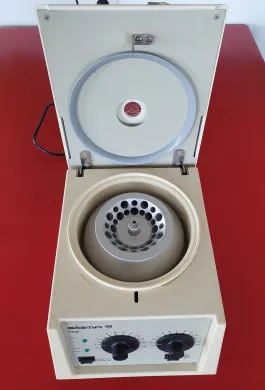
Sigma 202 benchtop centrifuge equipped with oscillating bucket rotor
Building year: 1988 Maximum speed: 10000rpm. Timer can be set between 1 to 30 minutes; Rotor capacity of 2x5 tubes of about 15ml + 2x1 tube of about 50ml
Other Sigma rotors available on request
The Sigma 202 laboratory centrifuge with oscillating bucket rotor is an older model of centrifuge, but it remains a highly reliable and effective tool for many laboratory applications.
One of the main advantages of this Sigma 202 centrifuge is that it is equipped with an oscillating bucket rotor. This design allows for gentle mixing of samples while they are being centrifuged, which can help to prevent sample damage and maintain sample integrity. Additionally, the oscillating bucket rotor can be used for a wide range of applications, including the separation of cells, proteins, and nucleic acids.
Another advantage of the Sigma 202 centrifuge itself is its speed and versatility. With this rotor, it has a maximum speed of 5,000 RPM, which is suitable for a wide range of laboratory applications. The centrifuge is also equipped with a range of programmable functions, including speed, time, and acceleration/deceleration settings, which can be customized to meet the specific needs of your application.
Despite being an older model of centrifuge, the Sigma 202 remains a highly reliable and effective tool for laboratory professionals. Its sturdy construction, ease of use, and range of programmable settings make it a valuable asset for many laboratory applications.
However, it is worth noting that newer models of centrifuges may offer additional features and advancements in technology that could be beneficial for some applications. It is always important to carefully consider your specific laboratory needs and budget when selecting equipment, and to consult with a knowledgeable supplier or expert in the field. But if you don't need all the newest stuff, this centrifuge may well be suitable for you!
Lab equipment markets are fragmented. Buyers spend weeks calling distributors, comparing quotes, and verifying supplier reliability. Sellers struggle to reach global research labs.
We built Questpair to fix this. Every supplier on the platform is verified before listing. Every quote you receive comes from a real, vetted seller. AI prepares your case in minutes, then a real specialist takes over.
We're an independent team based in The Netherlands, working with research labs and procurement teams across Europe and worldwide.
With a service contract, ten to fifteen years is normal for most benchtop instruments. Detectors and pumps are the parts that wear first.
Often, yes. Verified suppliers frequently work with service partners converting the instrument. If applicable, we can list servicing options alongside the offer.
Ask a scientist through the request button. Parts are often available even when the instrument itself is discontinued.
Two to six weeks, depending on refurbishment scope and whether calibration is included.
We ship to 38 countries. Crating and customs handling are quoted with the instrument.
Tell us what you need and a scientist finds it for you, usually within the hour.
Last updated 21 October 2026
€500 sits in the middle range benchtop centrifuges here. The middle half of the 80 with a price runs from €57 to €1,212.
1 other listing of this model is available.