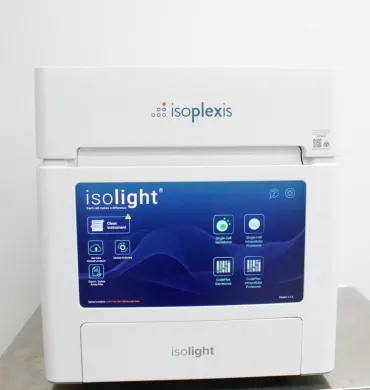
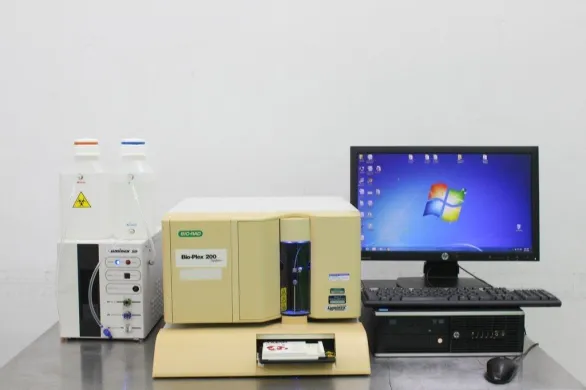
Price on request
In stock
Can't find what you're looking for?
Pre-Owned
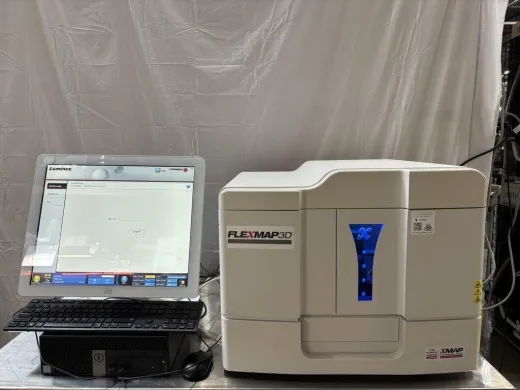
Flow cytometry bead reader enabling multiplex assays up to 500 analytes in 96/384-well plates.
The Luminex FlexMAP 3D is a flow-based bead reader and multiplexing flow cytometry microplate reader designed for high-throughput analysis of up to 500 analytes per well using xMAP bead-based technology. It supports 96- and 384-well microtiter plates with sample volumes ranging from 10 to 200 µL. Equipped with dual lasers—a 532 nm Reporter Laser and a 638 nm Classification Laser—and sensitive photomultiplier tubes and avalanche photodiodes, FlexMAP 3D provides precise bead classification and signal detection with a dynamic range of 4.5 logarithmic units.
Key technical features include:
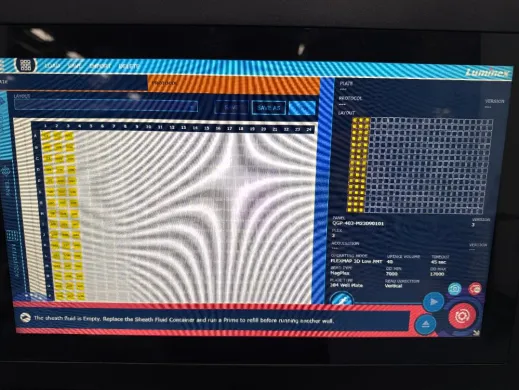
The instrument includes the Xponent software (version 4.3) for control, data acquisition, and report generation, and features stringent maintenance and calibration protocols to ensure optimal laser alignment, minimal electronic noise, and consistent fluidic performance. It is widely adopted in biotechnology research fields such as gene expression analysis, cytokine profiling, immunoassay development, and biomedical engineering.
Its design supports comprehensive multiplex immunoassay workflows critical in biopharmaceutical production pipelines and molecular diagnostics, offering sensitive, reproducible, and automatable results suitable for clinical research and biomanufacturing applications.
This FlexMAP 3D system is fully serviced, inspected for fluidics and optics integrity, and comes with a warranty and technical support, ensuring reliability for demanding laboratory environments. The system’s advanced multiplexing capability makes it indispensable for researchers focusing on biotechnology and molecular biology, enabling efficient, large-scale assays with minimized cross-reactivity and accurate biomolecule quantification.
Lab equipment markets are fragmented. Buyers spend weeks calling distributors, comparing quotes, and verifying supplier reliability. Sellers struggle to reach global research labs.
We built Questpair to fix this. Every supplier on the platform is verified before listing. Every quote you receive comes from a real, vetted seller. AI prepares your case in minutes, then a real specialist takes over.
We're an independent team based in The Netherlands, working with research labs and procurement teams across Europe and worldwide.
With a service contract, ten to fifteen years is normal for most benchtop instruments. Detectors and pumps are the parts that wear first.
Often, yes. Verified suppliers frequently work with service partners converting the instrument. If applicable, we can list servicing options alongside the offer.
Ask a scientist through the request button. Parts are often available even when the instrument itself is discontinued.
Two to six weeks, depending on refurbishment scope and whether calibration is included.
We ship to 38 countries. Crating and customs handling are quoted with the instrument.
Tell us what you need and a scientist finds it for you, usually within the hour.
Last updated 22 October 2026
The middle half of the 25 with a price runs from €2,221 to €9,614.