Price on request
In stock
Can't find what you're looking for?
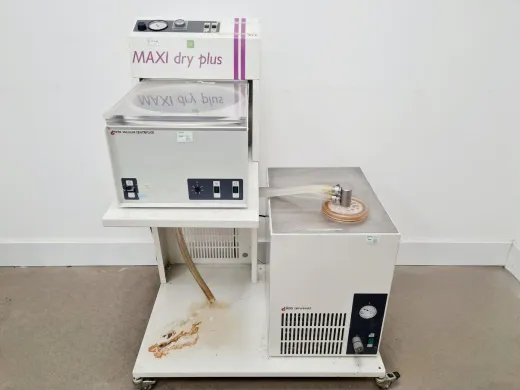
ScanVac ScanSpeed 40 vacuum centrifuge for centrifugal vacuum concentration, with 130 vial positions, programmable heating and vacuum readout.
The ScanVac ScanSpeed 40 vacuum centrifuge is a centrifugal vacuum concentrator for sample concentration in life sciences laboratories. It supports evaporation applications as a standalone system and is compatible with cold traps and vacuum pumps for integrated systems.
The unit has a large-capacity rotor program for adapting different vial types. Built-in heating is adjustable from +5 to +80 degrees C. A programmable timer provides automatic start and stop control. The integrated vacuum valve and safety break support safer operation.
The used unit has been tested in the laboratory and is in good condition. The inner glass plate is intact but has several cracks. The plate can be replaced if required.
The ScanVac ScanSpeed 40 is a centrifugal vacuum concentrator with a 200 to 2000 rpm operating speed and a rotor capacity of 130 1.5 ml Eppendorf vials. The rotor program allows adaptation to different vial types.
The used unit has been tested in the laboratory and is in good condition. The inner glass plate is intact but has several cracks and can be replaced if required.
The adjustable heating range changes the evaporation conditions available during concentration. The vacuum readout reaches 10^-3 mbar, supporting leak checks and control of sample dryness during a run.
The rotor accommodates up to 130 1.5 ml Eppendorf vials. The capacity supports parallel concentration of multiple small-volume samples in one run.
Lab equipment markets are fragmented. Buyers spend weeks calling distributors, comparing quotes, and verifying supplier reliability. Sellers struggle to reach global research labs.
We built Questpair to fix this. Every supplier on the platform is verified before listing. Every quote you receive comes from a real, vetted seller. AI prepares your case in minutes, then a real specialist takes over.
We're an independent team based in The Netherlands, working with research labs and procurement teams across Europe and worldwide.
With a service contract, ten to fifteen years is normal for most benchtop instruments. Detectors and pumps are the parts that wear first.
Often, yes. Verified suppliers frequently work with service partners converting the instrument. If applicable, we can list servicing options alongside the offer.
Ask a scientist through the request button. Parts are often available even when the instrument itself is discontinued.
Two to six weeks, depending on refurbishment scope and whether calibration is included.
We ship to 38 countries. Crating and customs handling are quoted with the instrument.
Tell us what you need and a scientist finds it for you, usually within the hour.
Last updated 29 October 2026
The middle half of the 1,511 with a price runs from €179 to €3,234.