From€7,634.58excl. VAT
In stock
Can't find what you're looking for?
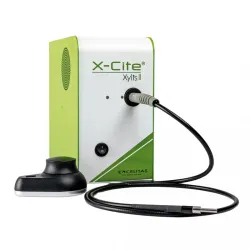
Broad-spectrum LED fluorescence light source (360–770 nm) with XT730S/XT730L UV options, ideal for microscopy imaging.
The X-Cite XYLIS II by Excelitas Technologies is a high-performance LED fluorescence light source designed for *compound* and *stereo microscopes*, providing broad-spectrum excitation from 360 nm to 770 nm covering fluorophores from *DAPI* to *Cy7*. This instrument employs patented LaserLED Hybrid Drive® technology to deliver continuous high-intensity illumination with spectral peaks at 365/385, 430, 475, 545, 635, and 735 nm, supporting a comprehensive range of fluorophores relevant to biotechnology and molecular diagnostics.
Available in two models:
Both models feature a liquid-light-guide output for efficient light transmission and multiple control interfaces including manual speedDIAL, TTL, USB, and an optional foot pedal, enabling seamless integration into automated fluorescence imaging workflows. The system achieves brightness comparable to traditional arc lamps but offers superior instant ON/OFF switching, low maintenance, and a notably long LED lifespan (~25,000 hours), eliminating the need for frequent bulb replacements and reducing operational costs.
Engineered for quiet laboratory environments, the XYLIS II operates at approximately 10 dB quieter than its predecessor, enhancing usability in multi-user microscopy suites and biomanufacturing facilities. Its fast switching speeds (100 µs TTL, 1 ms USB) make it well-suited for time-lapse imaging, live-cell fluorescence microscopy, immunofluorescence assays, and multicolor staining protocols—applications widely used in synthetic biology, molecular cloning workflows, and advanced biomedical research.
This LED fluorescence light source is essential for researchers in molecular biology, biotechnology, and clinical diagnostics requiring reliable and versatile illumination for advanced microscopy, including FISH, live-cell imaging, and complex multicolor fluorescence analysis.
Lab equipment markets are fragmented. Buyers spend weeks calling distributors, comparing quotes, and verifying supplier reliability. Sellers struggle to reach global research labs.
We built Questpair to fix this. Every supplier on the platform is verified before listing. Every quote you receive comes from a real, vetted seller. AI prepares your case in minutes, then a real specialist takes over.
We're an independent team based in The Netherlands, working with research labs and procurement teams across Europe and worldwide.
With a service contract, ten to fifteen years is normal for most benchtop instruments. Detectors and pumps are the parts that wear first.
Yes. Every verified supplier states which service partners cover the instrument, and we list that alongside the offer.
Ask a scientist through the request button. Parts are often available even when the instrument itself is discontinued.
Two to six weeks, depending on refurbishment scope and whether calibration is included.
We ship to 38 countries. Crating and customs handling are quoted with the instrument.
Tell us what you need and a scientist finds it for you, usually within the hour.
Last updated 19 October 2026
€7,635 sits above most lighting here. The middle half of the 713 with a price runs from €85 to €669.