€11,207.49excl. VAT
In stock
Can't find what you're looking for?
Durable cement autoclave with high safety features for precise pressure tasks.
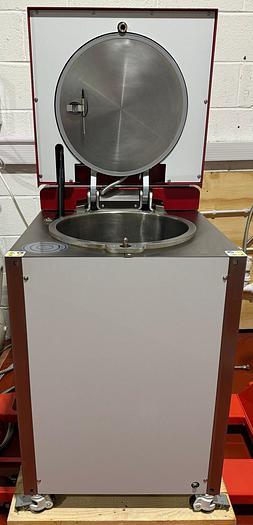
Boekel Scientific 25515016 Cement Autoclave The Cement Autoclave consists of a welded ASME certified steel cylinder with a bolted cover mounted on a sturdy supporting frame and enclosed in a heat insulated metal housing. The unit is designed to handle pressure in the 60-350 psi (0.4 -2.4 MPa) range and consists of steam vessel, pressure regulator, pressure gauge (0-600psi), air vent valve, power switches, and a safety pop valve set at 350 psi. All components are pressure tested and designed to meet the highest safety standards.
The autoclave consists of a welded steel cylinder with bolted cover, mounted on a sturdy supporting frame and enclosed in a heat insulated metal housing. The steel cylinder is fitted with a high temperature gasket and a heavy cover held in place by 16 cap screws bearing upon washers. A T-Handle wrench supplied with the autoclave may be used to tighten the nuts gradually and uniformly to make a leak-proof assembly. The cylinder assembly is designed for a safe working pressure of 525 PSIG, or one and one-half the maximum working pressure. A safety valve set to release at 350 PSIG is provided for protection and modification is not recommended for safe operation. A dial pressure gage indicates the steam pressure in PSIG. Temperature readings are taken with a No. NP22507 thermometer ASTM #2F, which is placed in the thermometer well provided in the cylinder cover. An air-vent valve allows the escape of entrapped air during the early part of the heating period and releases any steam pressure remaining at the end of the cooling period.
The autoclave is heated by two electric heaters attached to the cylinder. The heating unit is controlled from a switch panel on the control box. The control box houses the pressureregulator. A main toggle switch controls the entire electrical circuit including the automatic regulator. Separate on-off toggle switches, in series with pilot lights, control the current to the two heating elements. Switch functions are indicated on the switch panel.INCLUDED: The Boekel Scientific 25515016 Cement Autoclave includes:
Lab equipment markets are fragmented. Buyers spend weeks calling distributors, comparing quotes, and verifying supplier reliability. Sellers struggle to reach global research labs.
We built Questpair to fix this. Every supplier on the platform is verified before listing. Every quote you receive comes from a real, vetted seller. AI prepares your case in minutes, then a real specialist takes over.
We're an independent team based in The Netherlands, working with research labs and procurement teams across Europe and worldwide.
With a service contract, ten to fifteen years is normal for most benchtop instruments. Detectors and pumps are the parts that wear first.
Yes. Every verified supplier states which service partners cover the instrument, and we list that alongside the offer.
Ask a scientist through the request button. Parts are often available even when the instrument itself is discontinued.
Two to six weeks, depending on refurbishment scope and whether calibration is included.
We ship to 38 countries. Crating and customs handling are quoted with the instrument.
Tell us what you need and a scientist finds it for you, usually within the hour.
Last updated 19 October 2026
€11,207 sits above most autoclaves or sterilizers here. The middle half of the 186 with a price runs from €160 to €9,435.