53k+ listingsShips to NLResponse within one hour+31 73 711 4717info@questpair.com
Procurable · sourced on request

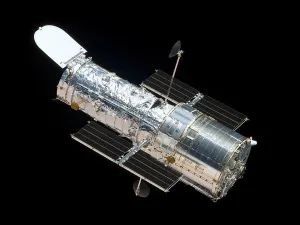
NASA Hubble Space Telescope (HST)

UsedNASALasersNetherlands
Procurable

Not in stock, available to order through our sourcing team

Not in stock, but we can get it for you

We source this model through our supplier network. Request a quote and we'll come back within one hour.

  1. Request a quote
  2. We confirm price and lead time
  3. You approve, we ship to you
Length
13,200 mm
Width
4,200 mm
Height
4,200 mm
Mass
12,200 kg
Primary Mirror Diameter
2,400 mm
Availability
Procurable
Lead time
Confirmed with your quote
All 21 specifications
  • Ships to NL
  • Response within 1 hour
  • Warranty available. Buy without worry
  • Support from a scientist

Specifications 21

Brands
NASA
New/Used
Used
Length
13,200 mm
Width
4,200 mm
Height
4,200 mm
Mass
12,200 kg
Primary Mirror Diameter
2,400 mm
Secondary Mirror Diameter
300 mm
Focal Length
56,700 mm
Orbit Altitude
600,000 m
Orbit Period
95.42 minutes
Power Generation
5,200 W
Power Consumption
2,100 W
Battery Capacity
500 Ah
Pointing Accuracy
0.007 arcseconds
Number of Observations
1,600,000
Number of Peer-Reviewed Publications
21,000
Data Transmission Rate
1,000,000 bps
Data Storage Capacity
24,000,000,000 bits
Availability
Procurable
Lead time
Confirmed with your quote

Product description

Space-based observatory with 2.4m mirror, capturing UV, visible, and near-IR data in low Earth orbit.

Hubble Space Telescope (HST), launched in 1990, is a pioneering space-based observatory that has profoundly transformed our understanding of the universe. Operating above Earth's atmosphere, this telescope captures high-resolution images across ultraviolet, visible, and near-infrared wavelengths, enabling detailed studies of celestial phenomena.

Key features include:

  • 2.4-metre primary mirror: Provides exceptional light-gathering capability for observing distant objects.
  • Advanced scientific instruments: Equipped with cameras and spectrographs for comprehensive data collection.
  • Low Earth orbit: Minimises atmospheric distortion, enhancing image clarity.

HST has been instrumental in various scientific domains:

  • Cosmology: Measuring the universe's expansion rate and age.
  • Exoplanet research: Analysing atmospheres of planets beyond our solar system.
  • Galactic evolution: Observing distant galaxies to understand their formation and development.

This observatory is widely utilised by:

  • University laboratories: Conducting astrophysical research and student training.
  • Space agencies: Collaborating on international astronomical studies.
  • Research institutions: Advancing knowledge in various fields of space science.

Since its deployment, HST has made over 1.6 million observations, leading to more than 21,000 peer-reviewed publications. Despite challenges, including gyroscope failures, it continues to operate and contribute to scientific discoveries. HST is expected to remain functional into the 2030s, continuing its legacy of exploration and discovery.

Why Questpair exists

Lab equipment markets are fragmented. Buyers spend weeks calling distributors, comparing quotes, and verifying supplier reliability. Sellers struggle to reach global research labs.

We built Questpair to fix this. Every supplier on the platform is verified before listing. Every quote you receive comes from a real, vetted seller. AI prepares your case in minutes, then a real specialist takes over.

We're an independent team based in The Netherlands, working with research labs and procurement teams across Europe and worldwide.

Frequently asked questions

How long does laboratory equipment typically last?

With a service contract, ten to fifteen years is normal for most benchtop instruments. Detectors and pumps are the parts that wear first.

Can I get service for older equipment?

Often, yes. Verified suppliers frequently work with service partners converting the instrument. If applicable, we can list servicing options alongside the offer.

Where can I buy parts?

Ask a scientist through the request button. Parts are often available even when the instrument itself is discontinued.

What is the typical lead time for refurbished equipment?

Two to six weeks, depending on refurbishment scope and whether calibration is included.

Does laboratory equipment ship internationally?

We ship to 38 countries. Crating and customs handling are quoted with the instrument.

Reply in one hour

Can't find the exact configuration?

Tell us what you need and a scientist finds it for you, usually within the hour.

Last updated 3 November 2026