58k+ listingsShips to NLResponse within one hour+31 73 711 4717info@questpair.com
Procurable · sourced on request

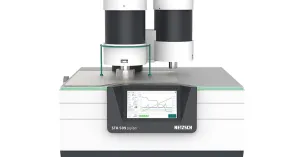
Netzsch STA 449 F3 Jupiter

UsedNetzschThermal analysisNetherlands
Procurable

Not in stock, available to order through our sourcing team

Not in stock, but we can get it for you

We source this model through our supplier network. Request a quote and we'll come back within one hour.

  1. Request a quote
  2. We confirm price and lead time
  3. You approve, we ship to you
Temperature Range
-150 °C to 2400 °C
Atmosphere Options
Inert, oxidizing, reducing, static, dynamic
Vacuum-Tight Assembly
Up to 10⁻⁴ mbar
Heating and Cooling Rates
0.001 K/min to 50 K/min
TGA Resolution
0.1 µg
Availability
Procurable
Lead time
Confirmed with your quote
All 14 specifications
  • Ships to NL
  • Response within 1 hour
  • Warranty available. Buy without worry
  • Support from a scientist

Specifications 14

Brands
Netzsch
New/Used
Used
Temperature Range
-150 °C to 2400 °C
Atmosphere Options
Inert, oxidizing, reducing, static, dynamic
Vacuum-Tight Assembly
Up to 10⁻⁴ mbar
Heating and Cooling Rates
0.001 K/min to 50 K/min
TGA Resolution
0.1 µg
DSC Resolution
<1 µW (sensor type S), 0.5 µW (sensor type E)
Balance Drift
<5 µg/hour
Weighing Range
35,000 mg
Automatic Sample Changer Capacity
Up to 20 samples
Coupling Options
FT-IR, MS via Capillary or SKIMMER coupling
Availability
Procurable
Lead time
Confirmed with your quote

Product description

High-performance STA combining TGA and DSC, operating 25–1600 °C with sub-microgram resolution.

The NETZSCH STA 449 F3 Jupiter® is a high-performance Simultaneous Thermal Analyzer (STA) designed for precise measurement of mass changes and thermal effects in materials. By integrating Thermogravimetric Analysis (TGA) and Differential Scanning Calorimetry (DSC), this instrument enables comprehensive thermal analysis in a single experiment.

Key features:

  • Wide temperature range: Operates from 25 °C to 1600 °C, accommodating diverse thermal analysis requirements.
  • High sensitivity: Features a sub-microgram-resolution thermobalance for detecting minute mass changes.
  • Versatile furnace options: Equipped with interchangeable furnaces, including silicon carbide and rhodium, to suit various applications.
  • Evolved Gas Analysis (EGA): Couples with Mass Spectrometry (MS) and Fourier-Transform Infrared Spectroscopy (FT-IR) for real-time analysis of evolved gases.
  • Automatic Sample Changer (ASC): Enhances throughput with minimal human intervention, accommodating up to 20 samples.
  • Vacuum-tight design: Allows measurements under defined environments, including vacuum, inert, and reactive atmospheres.

Applications:

  • Biotechnology: Essential for assessing thermal stability and decomposition of biomaterials, polymers, and pharmaceuticals.
  • Materials science: Investigates phase transitions, crystallinity, and thermal decomposition of advanced materials.
  • Energy storage research: Analyzes thermal properties of materials used in batteries and fuel cells.
  • Environmental science: Studies thermal behavior of waste materials for energy recovery applications.

Commonly used in:

  • University laboratories: Supports academic research in material characterization and thermal analysis.
  • Biotechnology companies: Facilitates quality control and development of biopharmaceuticals and biomaterials.
  • Research institutes: Enables advanced studies in material science and engineering.
  • Industrial R&D centers: Assists in product development and quality assurance across various sectors.

First introduced in the early 2000s, the NETZSCH STA 449 F3 Jupiter® remains a cornerstone in thermal analysis, widely adopted in biotechnology and materials science for its precision and versatility.

Why Questpair exists

Lab equipment markets are fragmented. Buyers spend weeks calling distributors, comparing quotes, and verifying supplier reliability. Sellers struggle to reach global research labs.

We built Questpair to fix this. Every supplier on the platform is verified before listing. Every quote you receive comes from a real, vetted seller. AI prepares your case in minutes, then a real specialist takes over.

We're an independent team based in The Netherlands, working with research labs and procurement teams across Europe and worldwide.

Frequently asked questions

How long does laboratory equipment typically last?

With a service contract, ten to fifteen years is normal for most benchtop instruments. Detectors and pumps are the parts that wear first.

Can I get service for older equipment?

Often, yes. Verified suppliers frequently work with service partners converting the instrument. If applicable, we can list servicing options alongside the offer.

Where can I buy parts?

Ask a scientist through the request button. Parts are often available even when the instrument itself is discontinued.

What is the typical lead time for refurbished equipment?

Two to six weeks, depending on refurbishment scope and whether calibration is included.

Does laboratory equipment ship internationally?

We ship to 38 countries. Crating and customs handling are quoted with the instrument.

Reply in one hour

Can't find the exact configuration?

Tell us what you need and a scientist finds it for you, usually within the hour.

Last updated 22 October 2026