Every once in a while, we highlight new laboratory technologies as part of the QuestPair Highlights blog series. In this edition, we focus on an exciting new technology that makes it possible to culturing cells under flow conditions, e.g. to mimic those in living tissue – over to ARTIC Technologies.
In 3D cell culture research, creating physiologically relevant conditions often comes at a cost: either you get high throughput with static systems, or dynamic flow with complex, low-throughput setups. At ARTIC Technologies, we believe it’s time to break this trade-off. That’s why we’re developing the MAC plate: a scalable, user-friendly platform for dynamic 3D cell culture with integrated flow.
The problem: flow comes at a price
Physiological flow is essential for mimicking in vivo conditions in 3D culture models. However, introducing this flow often requires complex microfluidic setups that for example include tubing. These solutions are difficult to scale and rarely fit into standard lab workflows. An emerging and more user-friendly development is the use of periodically tilting platforms, but also those often insufficiently mimic in vivo conditions.
Our solution: The MAC plate
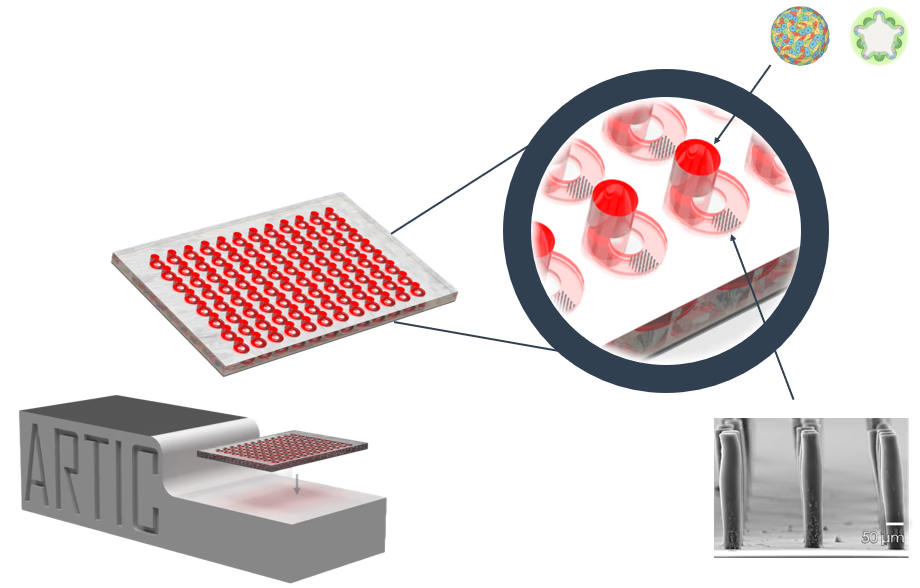
Our technology makes use of hair-like structures called cilia, which in their natural form be found in organisms where they move to provide for the transportation of fluids and cells. It is also possible to make artificial cilia and use them for a variety of microfluidic applications and devices. The MAC plate (figure below) makes use of Magnetic Artificial Cilia (MAC) technology and combines physiological flow with the convenience of standard lab equipment to provide the following:
- Gentle flow: a smooth, controlled, and biologically relevant flow around the cell culture, enabled by magnetic microhairs, so-called Magnetic Artificial Cilia (MAC). The cilia used on the MAC plate are roughly 50 µm thick and 350 µm long flexible cylindrical structures that are powered by a magnetic actuator to generate a fluid flow.
- Standards compatible: dimensions and well layout match those of standard well plates.
- Familiar workflow: compatible with typical imaging and media exchange procedures.
- Automation-ready: supports robotic and multi-channel pipetting.
How it works
1. Seed your 3D cell model in the wells of the MAC plate.
2. Place the MAC plate on the magnetic actuation system.
3. The MAC, placed in the channels around the well, are now actuated by the actuation system (see video below). Their movement leads to medium circulation, without tubing or other pumps, just flow.
Why it matters
The MAC plate makes dynamic cell culture accessible and scalable. It enables more physiologically relevant models without disrupting standard workflows, ideal for academic labs, biotech R&D teams, and drug discovery applications in pharma.
About ARTIC Technologies
We are a spin-off from Eindhoven University of Technology, developing fluid manipulation technologies for life sciences. With our work deeply rooted in science, we aim to bring dynamic culture into the mainstream cell culture.