
Every so often, we showcase emerging laboratory and analytical technologies in our blog series QuestPair Highlights. In this edition, we take a closer look at a holographic microscopy technique that enables true real-time measurements and bioprocess monitoring. As with our previous feature, the use case is clearly defined, and the potential for a paradigm shift is considerable in industries such as biopharmaceutical manufacturing, water and environmental monitoring, and food and beverage production. Over to Holloid!
Although light microscopy is a well-established standard of any image-based analysis, different types of innovative imaging methods are being developed to overcome the limitations of light microscopy. Especially, if the imaging is slow, low-throughput and manual. Holloid eradicates these bottlenecks.
Holloid was founded in 2022 as a spin-off from Vienna’s BOKU University and is based on a technology developed at the Institute of Colloid and Biointerface Science (ICBS), Department of Natural Sciences and Sustainable Resources. It commercialises several inventions in the field of digital holographic microscopy. In digital holographic microscopy (DHM), the full light wavefront from an object is recorded rather than just its projected image. By capturing both intensity and phase information through interference with a reference wave, a digital hologram is formed. The object image is then computationally reconstructed from the hologram using numerical algorithms that simulate the propagation of the recorded wavefront, much like a traditional optical lens would at different focal planes. A key advantage of DHM is the ability to retrieve information about objects at different depths, so in three dimensions, within a sample without physically refocusing.
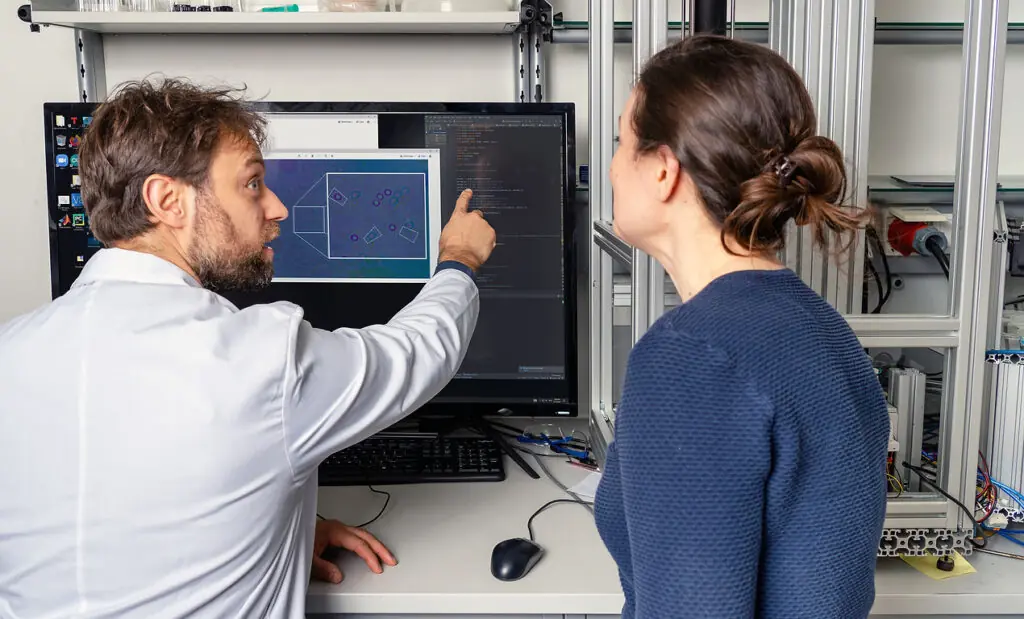
holographic microscopy images to track objects in 3D in real time
Holloid’s innovation uses holographic in-line phase-contrast microscopy, where the reference and object waves travel in the same direction. This enhances the visibility of transparent or weakly absorbing objects such as microorganisms by turning phase shifts into measurable image contrast. Their technology revolutionises the information available for bioreactor processes control, hygiene and environmental monitoring. Specifically, their 3D imaging technology allows for imaging of, e.g., yeasts, bacteria, and cell cultures in large volumes very fast to distinguish what they are and what state they are in. The hardware has been miniaturised to a device as small as a shoebox that can be installed and accessed anywhere over the internet.
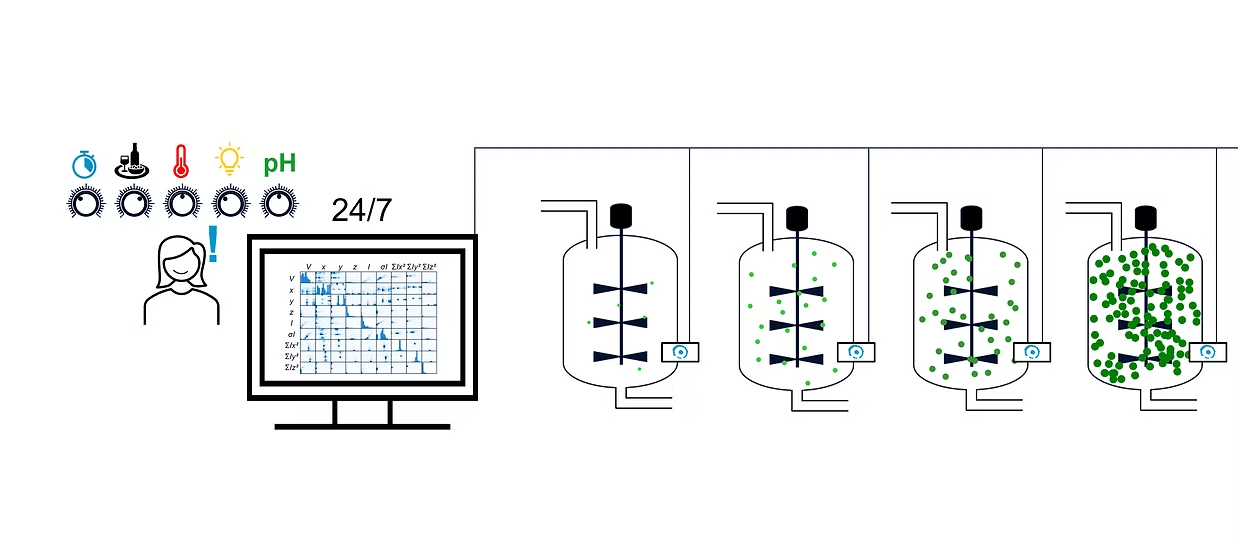
The core of Holloid’s unique technology is the software to digitally analyse holographic data in real-time, providing a wealth of information on the level of individual microorganisms – far more detailed than would be obtained using only conventional light microscopy – and with a few million times higher throughput, all fully automated. This is something that truly sets Holloid apart: in-line phase-contrast holography, powered by proprietary algorithms, supported by AI, bringing continuous, 24/7 visibility into the heart of bioreactors – without needing expert intervention or disrupting sterile conditions.
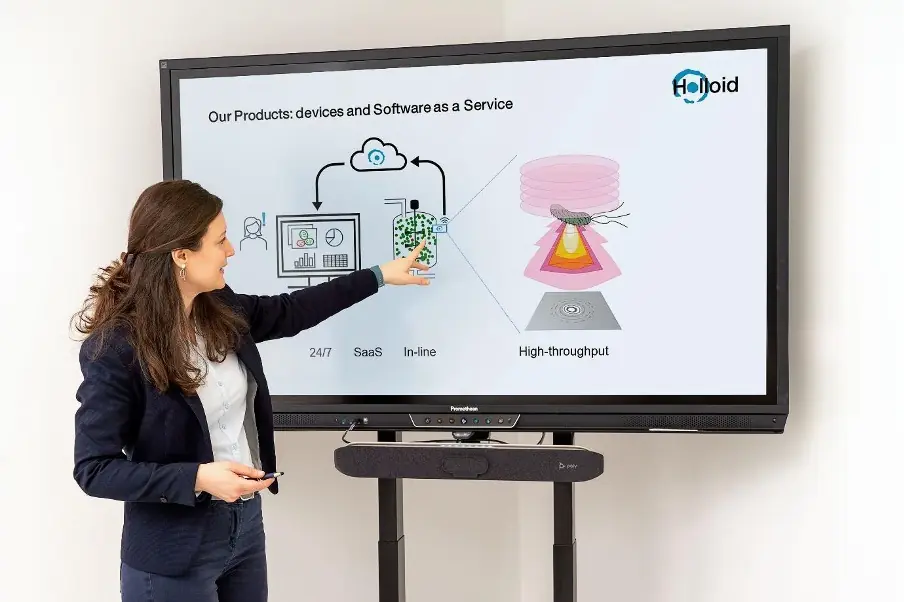
Bioreactors are often considered black boxes – valuable data remains hidden, slowing down decision-making and efficiency. Holloid changes that narrative, as their comprehensive system automates image-based monitoring, giving production managers and quality assurance (QA) teams the information needed to optimize harvest times, tweak parameters and even trigger automated responses.
Personalised solutions for all your needs – whether it’s sparking speedier decisions in pharma and chemical industry, enhancing food safety, or boosting the yield of microalgae-based products, Holloid’s tool brings clarity where there was none.
Meet the team:

???? Would you like to have a look at how beneficial our technology can be for you? Please reach out to info@holloid.com or contact us here: https://www.holloid.com/contact
Or visit us here:
???? Website: www.holloid.com
???? LinkedIn: LinkedIn page